 |
John
Kenneth Galbraith (1908-2006) |
|
John Kenneth Galbraith is
one of the most widely read economists in the United States. One reason is
that he writes so well. He turns a clever phrase that often makes those he
argues against look foolish. Galbraith's first major book, published in
1952, was American Capitalism: The Concept of Countervailing Power.
In it he argued that giant firms had replaced small ones to the point
where the perfectly competitive model no longer applied to much of the
American economy. But not to worry, he argued. The power of large firms
was offset by the countervailing power of large unions, so that consumers
were protected by competing centers of power.
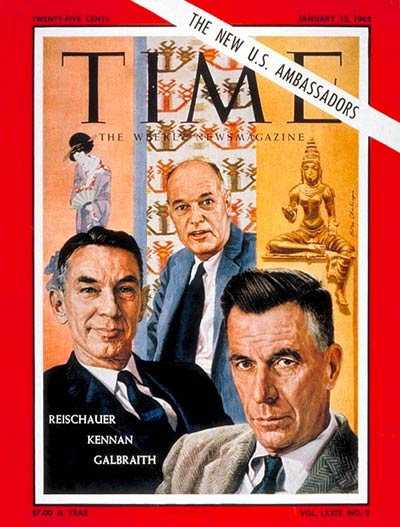
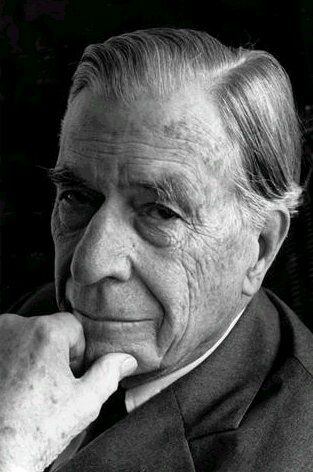
Galbraith made his biggest splash with his 1958 book, The Affluent Society. In that volume he contrasted the affluence of the private sector with the squalor of the public sector. Many people liked that book because of their view that Galbraith, like Veblen before him, attacked production that was geared to "conspicuous consumption." But that is not what Galbraith did. In fact, Galbraith argued that "an admirable case can still be made" for satisfying even consumer wants that "have bizarre, frivolous, or even immoral origins." His argument against satisfying all consumer demands was more subtle. Galbraith wrote: "If the individual's wants are to be urgent, they must be original with himself. They cannot be urgent if they must be contrived for him. And above all, they must not be contrived by the process of production by which they are satisfied.... One cannot defend production as satisfying wants if that production creates the wants." Friedrich Hayek made the most fundamental criticism of Galbraith's argument. Hayek conceded that most wants do not originate with the individual. Our innate wants, he wrote, "are probably confined to food, shelter, and sex." All other wants we learn from what we see around us. Probably all our aesthetic feelings—our enjoyment of music and literature, for example—are learned. So, wrote Hayek, "to say that a desire is not important because it is not innate is to say that the whole cultural achievement of man is not important." Galbraith's magnum opus was his 1967 book, The New Industrial State. Galbraith argued that the American economy was dominated by large firms. "The mature corporation," wrote Galbraith, "had readily at hand the means for controlling the prices at which it sells as well as those at which it buys." Galbraith wrote: "Since General Motors produces some half of all the automobiles, its designs do not reflect the current mode, but are the current mode. The proper shape of an automobile, for most people, will be what the automobile makers decree the current shape to be." The evidence has not been kind to Galbraith's thesis. Even our largest firms lose money if they fail to produce a product that consumers want. The U.S. market share of GM, for example, one of Galbraith's favorite examples of a firm invulnerable to market forces, has fallen from about 50 percent when Galbraith wrote the book to about 30 percent today. Galbraith is also one of the cofounders, along with James Buchanan and Gordon Tullock, of public choice theory (see Public Choice Theory). Prior to the emergence of public choice theory, economists tended to ascribe to the government the role of an infallible controller with perfect information and unlimited power—an entity which the economist David Friedman called a "bureaucrat god". However, in practice bureaucrats and politicians are only humans, and they often face incentives that draw them to decisions that produce inefficient outcomes. Since the basic assumption of the theory is that humans are rational beings that act in a self-interested way, it was thought that the economic analysis of the political decision-making process might reveal certain systematic trends towards inefficient government policies. Public choice theorists focus on the question of what government policies are likely to be implemented in a given political setting, rather than what policies would produce a desirable outcome if they were implemented. One of the basic claims that underlie public choice theory is that good government policies in a democracy are an underprovided public good, because of the rational ignorance of the voters. Each voter is faced with an infinitesimally small probability that his vote will change the result of the elections, while gathering the relevant information necessary for a well-informed voting decision requires substantial time and effort. Therefore, the rational decision for each voter is to be generally ignorant of politics and perhaps even abstain from voting. Rational choice theorists claim that this explains the gross ignorance of most citizens in modern democracies as well as low voter turnout. While the good government tends to be a pure public good for the mass of voters, there exists a plethora of various interest groups that have strong incentives for lobbying the government to implement specific inefficient policies that would benefit them at the expense of the general public. For example, lobbying by the sugar manufacturers might result in an inefficient subsidy for the production of sugar, either direct or by protectionist measures. The costs of such inefficient policy is dispersed over all citizens, and therefore unnoticeable to each individual. On the other hand, the benefits are shared by a very small special interest group, who has very strong incentives to perpetuate the policy by further lobbying. The vast majority of voters will be completely unaware of the whole affair due to the phenomenon of rational ignorance. Therefore, theorists expect that numerous special interests will be able to successfully lobby for various inefficient policies. In the public choice theory, such scenarios of inefficient government policies are referred to as government failure — a term akin to the market failure scenarios familiar from the traditional economic theory. Galbraith was born in Canada and moved to the United States in the thirties. He earned his Ph.D. in agricultural economics at the University of California at Berkeley. He was one of the chief price controllers during World War II as head of the Price Section of the U.S. government's Office of Price Administration. Unlike almost all other economists, Galbraith defends permanent price controls. In 1943 Galbraith left the government to be on the editorial board of Fortune. After the war he directed the U.S. Strategic Bombing Survey. That survey's main finding was that saturation bombing of Germany was not very effective at slowing down German war production. In 1949 he became an economics professor at Harvard, where he had been briefly before the war. He is still at Harvard. Galbraith has also been politically active—an adviser to President Kennedy, Kennedy's ambassador to India, and president of Americans for Democratic Action. He was president of the American Economic Association in 1972.
Selected WorksThe Affluent Society. 1958. American Capitalism. 1952. The New Industrial State. 1967. |