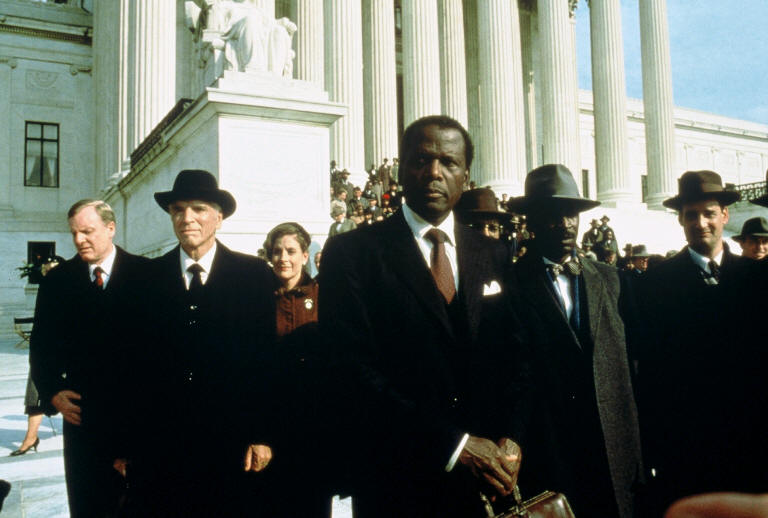
Separate But Equal
|
|
Cast & Credits
Thurgood Marshall.: Sidney Poitier John W. Davis: Burt Lancaster Earl Warren: Richard Kiley Robert Carter: Cleavon Little James Byrnes: John McMartin Written and Directed By IGeorge Stevens
Running Time: 187 Minutes. |
BY KEN TUCKER /April 7, 1991
It is 1950 in Clarendon County, S.C., where black children must walk as much as five or six miles to get to and from their run-down, segregated elementary school. The father of one of the students, an auto mechanic named Harry Briggs, decides he's had enough. Sick of seeing his young son trudge home too tired to do his homework, he enlists the boy's teacher to implore the local superintendent of schools to provide a bus.
The request is quickly and rudely turned down. As Separate But Equal shows, that small but significant incivility helped to inspire a series of legal petitions and decisions in Clarendon County and elsewhere that eventually resulted in Brown v. Board of Education, the landmark 1954 Supreme Court decision desegregating America's schools. The case also brought the shrewdness and eloquence of a young NAACP Legal Defense Fund lawyer, Thurgood Marshall, to the attention of the nation. Although he was overshadowed by more public figures such as Martin Luther King, Jr., Marshall is one of the most important and admirable heroes of the civil rights movement.
Separate But Equal describes history in big, broad strokes. After the bus request is denied, a group of Clarendon County blacks petition the state supreme court not only for a bus but also for school facilities and supplies equal in quality to those of the all-white schools in the area. Marshall, based in New York, hears about the petition and, along with his Legal Defense Fund colleagues, decides the Clarendon County situation is in keeping with a new nationwide movement toward desegregation.
At the state hearing, Marshall draws on the research of social psychologist Kenneth Clark, which suggests that segregation fosters discrimination and feelings of inferiority among black children. Linking the Clarendon County petition to desegregation cases simultaneously being brought to the U.S. Supreme Court by Kansas, Delaware, Virginia, and the District of Columbia, Marshall and the Legal Defense Fund bring their case to the Supreme Court. ''If we don't challenge the segregation laws,'' Marshall says, ''we will always be separate but never equal.''
The exhilaration of Separate But Equal — and despite its serious subject and solemn air, it is exhilarating — is in watching Marshall and his crew of overworked, underpaid NAACP lawyers put their case together; they transformed themselves into the David that would defeat the Goliath of segregation. Goliath, in this case, is personified by state attorney John W. Davis, who argues against the plaintiffs.
Davis, whose position was that ''legal segregation and discrimination are not the same thing,'' is full of quiet power and authority. And although Thurgood Marshall doesn't square with television's usual portrayal of great lawyers as impassioned showboaters, Marshall embodies the virtues of long, hard study and intellectualism.
Marshall himself became a Supreme Court justice in 1967, but Separate But Equal leaves him at a moment of youthful triumph, his case won and desegregation the law of the land. He remains characteristically modest: ''Sometimes history takes things into its own hands,'' he remarks. At a time when civil rights remains a crucial, complex issue in this country, Separate But Equal is a gratifyingly complex movie about a complex era in history.
|
ASSIGNMENT Consulting your textbook, notes, the short timeline of civil rights in America, and the transcripts of Marshall and Davis' closing arguments before the Supreme Court, discuss and give your opinion on the case of Brown v Board of Education. If you did not know the outcome of the case, would you be more more swayed Marshall's arguments or Davis'? How much of the case was won on legal precedent? How much by social science? How much was it determined by the personalities on the court? Could the case have been won without Earl Warren as Chief Justice? Write out your answers on the Blackboard Discussion Board no later than midnight Sunday, May 18. |