The August 2007 issue of Esquire featured a cocksure John
Edwards next to the cover line: CAN A WHITE MAN STILL BE
ELECTED PRESIDENT? At the time, the question was revisionist
sarcasm. But in the alternate reality of the hit drama "24,"
the question would be downright apropos.
When the show premiered in 2001, the plot centered on the
country's first viable black presidential contender, Sen.
David Palmer (Dennis Haysbert), and the efforts of dauntless
counterterrorism agent Jack Bauer (Kiefer Sutherland) to
fend off assassins. By the second season, Palmer had taken
office, where he remained through the following season. In
season six, the show had an echo of Robert F. Kennedy in the
form of Wayne Palmer (D. B. Woodside), David Palmer's
younger brother, who is elected as the second black
president following David's assassination. The seventh
season had its scheduled Jan. 13 premiere derailed by the
Hollywood writers' strike, but when it finally bows, Tony
winner Cherry Jones will play Allison Taylor, the
franchise's first female president. In fact, the show's only
white male president to be featured as a regular cast member
was the duplicitous President Charles Logan (Gregory Itzin),
whose complicity in the death of David Palmer couldn't have
been good for his approval ratings.
But "24" is fiction—or at least it was. This year,
reality is finally catching up with Hollywood. Now that the
candidacies of Hillary Clinton and Barack Obama are forcing
us to examine feelings about race, gender and power, there's
much insight to be gained from studying their fictional
ancestors. After all, the part of the president of the
United States is one of the few that could always be cast as
a white male, so any time a woman or a person of color has
been put into that role, it was done purposefully. How have
our depictions of black and female presidents reflected our
feelings about having one? How do they shape our current
opinions and comfort levels? And should Obama or Clinton
ascend to the presidency, how will the depictions change
once we've gone from "what if" to "what now?"
The possibilities of a black or female president have
been exploited since the time when such a premise would have
been considered fantasy—or, to some, a nightmare. The first
African-American to serve the role in the movies was James
Earl Jones in 1972's "The Man," an adaptation of a 1968
Irving Wallace novel. Jones plays Douglass Dilman, the
president pro tempore of the Senate who jumps the succession
line after an almost comic string of tragedies: the
President and Speaker of the House are killed when the
ceiling of a German palace collapses on them, and the Vice
President is too ill to take over. When Dilman assumes
office, he becomes the target of racially motivated attacks,
both on his life and on his job. The first female presidency
in film came earlier, but was no more flattering. In 1964's
"Kisses for My President," Polly Bergen plays President
Leslie McCloud, who is propelled into office by a gale force
of female voters. But the film is more about her husband,
Thad (Fred MacMurray), and his awkward attempts at being
First Husband. Despite being decades ahead of reality, the
essence of these films was very much of their
time—fear-mongering and reactionary. Each film spends a
disproportionate amount of time on the discomfort of racist
whites and macho men. The function of the films seems to be,
at the height of the women's and civil-rights movements, to
remind frightened white men that despite the progress and
possibilities, the glass ceiling was firmly intact.
Since those first fumbling attempts, there have been
other intermittent efforts to depict these characters: in
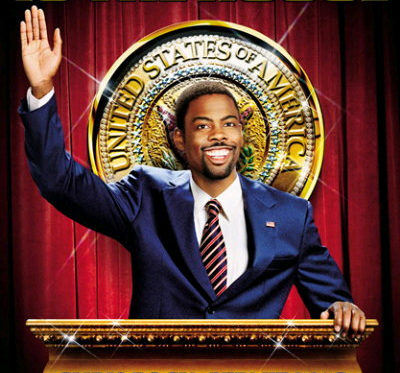
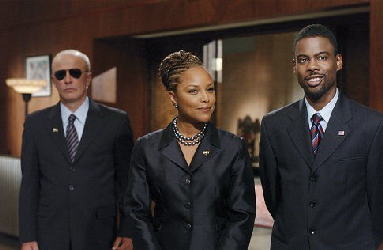
film, Chris Rock's "Head of State" (tag line: "The only
thing white is the house"); on television, a recurring
female president in "Prison Break." But the characters that
made the most impact were David Palmer of "24" and Mackenzie
Allen (Geena Davis) of "Commander in Chief." Their shows
were the first serialized dramas to attempt this race- and
gender-specific casting, providing a weekly opportunity to
sell America on the concept—and we do mean sell.
"We absolutely went into this with the agenda of making
America comfortable with the idea of a female president,"
says "Commander" creator Rod Lurie, who had previously
written and directed 2000's "The Contender," about the
brutal confirmation of a female vice president.
It may sound grandiose for Lurie to take partial credit
for helping voters warm to Clinton, but pop culture often
eases public acceptance of social issues. Ellen DeGeneres's
announcing her sexuality via her sitcom had an impact on the
way we view gays and lesbians. "The Jeffersons" normalized
the concept of interracial marriage. The effect Haysbert's
performance has had on our impression of Obama might be even
more dramatic, since Obama shares so much with President
Palmer. Palmer was suave, polite to a fault, blessed with a
gift for rhetoric and a buttery baritone with which to
present it.
"As far as the public is concerned the character did open
up their minds and their hearts a little bit to the notion
that if the right man came along … that a black man could be
president of the United States," says Haysbert, an active
Obama supporter. And Palmer's campaign and presidency were
conspicuously race-free, a tone Obama has strived for, if
not always achieved. The only time Palmer's race is
addressed on "24," it's a red herring, where it is revealed
that the assassination attempts he thought were racially
motivated were actually retribution for a botched military
operation he authorized.
The world of "Commander in Chief" was not nearly so
progressive, and the show's trajectory provides a glimpse
into the precarious work of shaping the image of an unlikely
president. Vice President Allen assumes the presidency after
President Teddy Bridges (Will Lyman) dies of a brain
aneurysm. The show was the most-watched of the 2005 fall
season, delivering huge audiences of female viewers. But
after the show's seventh episode, Lurie was fired,
reportedly due to script delays, and replaced by Steven
Bochco ("NYPD Blue").
In Bochco's retooling, the male characters came to the
fore. "She was always turning to her husband or to a man for
advice or approval, so the show was beginning to become not
about why we should have a female president, but why we
should not have one," Lurie says. "I don't know if I can
call myself a feminist, but I know that Bochco is not."
The show went from groundbreaking incumbent to lame
duck—canceled after one season.
"I hate that it turned out the way it did, because I
might not ever have a chance to work on something as
important," Lurie says.
Then again, his work is done—a woman is a front runner
for the White House. It will be interesting to see how that
scenario affects the next generation of fictional
presidents, starting with this season on "24." The producers
have installed their own cone of silence over the new
season, but chances are President Taylor, like President
Allen, will be stereotypically feminine, pretty, empathic
and family-oriented, but also extremely knowledgeable and
tough on defense issues, just as President Palmer was
pristine, eloquent and polite.
In other words, Taylor will be yet another idealized
version of a nonwhite-male president, the kind we'd hope
would take office and vanquish the remaining vestiges of
racial and gender prejudice.
But we don't live in these small-screen utopias. Our
candidates, regardless of race and gender, have skeletons.
Real politicians screw up. They contradict themselves.
Hollywood is building unreasonable expectations for our
real-life candidates—as well as reserving the juiciest parts
for white actors. When we have fictional black and female
presidents who are incompetent and evil and make great big
messes, it'll be proof that we've arrived at a place where
we can judge individuals on their merits. Then the answer to
the question "Can a white man still be elected president?"
will be "Of course, but so can anybody else."