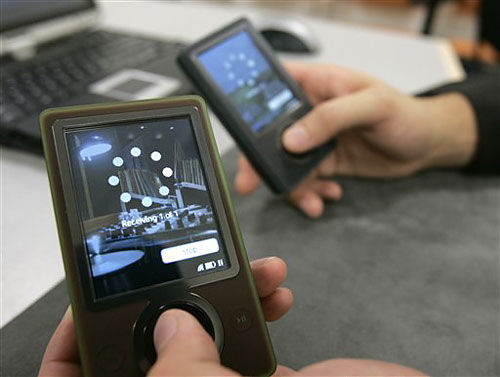
This week, Microsoft Corp. launches
the most serious challenge ever mounted to Apple
Computer's iPod and iTunes juggernaut in digital music.
The software giant is introducing a portable player
called the Zune, an online music store called Zune
Marketplace and a new music software program called Zune
that links the two. It plans to put plenty of marketing
muscle behind Zune, and promises to expand and refine
this new product line in coming years.
This isn't Microsoft's first effort to stop the iPod,
but it's the first for which the software giant is
adopting Apple's own business and design model -- where
one company makes and controls the hardware, software
and online component, and tightly integrates them. The
Zune is produced by Microsoft's Xbox group, which builds
game consoles on that same end-to-end principle.
In its first incarnation, the Zune comes in only one
version, a big, chunky $249 model that can hold 30
gigabytes of music, videos and photos. I've been testing
the Zune for the past couple of weeks and comparing it
with the most similar of Apple's six iPod models -- the
smaller of the two full-size iPods, which also holds 30
gigabytes and also costs $249.
Zune has several nice features the iPod lacks: a larger
screen, the ability to exchange songs with other Zunes
wirelessly and a built-in FM radio. It solves the worst
problem that plagued earlier Microsoft-based music
players -- frequent failures to synchronize properly
music and videos between the players and personal
computers. Synchronization on the Zune is smooth and
sure.
Also, the Zune player and software have a very good user
interface, different from, but in some cases easier to
use than, the iPod's. While it lacks the famous iPod
scroll wheel, instead using a common four-way navigation
pad, I found song lists easy to navigate on the Zune. It
has only a few buttons and is quite intuitive to use. To
my ears, it sounded as good as the iPod.
But this first Zune has too many compromises and missing
features to be as good a choice as the iPod for most
users. The hardware feels rushed and incomplete. It is
60 percent larger and 17 percent heavier than the
comparable iPod. It has much worse battery life for
music than the iPod or than Microsoft claims -- at least
two hours less than the iPod's, in my tests. Despite the
larger screen, many album covers look worse than they do
on the iPod. And you can't share music libraries between
computers like you can with iTunes.
Zune's online store offers far fewer songs, just over
two million, compared with 3.5 million for the iTunes
store. In fact, as of this writing, songs from one of
the big labels, Universal, were missing from Zune
Marketplace, though Microsoft says it is confident it
will have all the major labels when it launches Zune
tomorrow. Also, despite the player's capability, Zune
Marketplace offers none of the TV shows, movies or music
videos that iTunes does, and has no audiobooks or
podcasts.
Even worse, to buy even a single 99-cent song from the
Zune store, you have to purchase blocks of "points" from
Microsoft, in increments of at least $5. You can't just
click and have the 99 cents deducted from a credit card,
as you can with iTunes. You must first add points to
your account, then buy songs with these points. So, even
if you are buying only one song, you have to allow
Microsoft, one of the world's richest companies, to hold
on to at least $4.01 of your money until you buy
another. And the point system is deceptive. Songs are
priced at 79 points, which some people might think means
79 cents. But 79 points actually cost 99 cents.
Unlike iTunes, Zune offers subscription plans, where you
can get an unlimited number of songs for $15 a month.
However, Microsoft is de-emphasizing this option and
mostly positioning Zune Marketplace as a source of
individually purchased songs and albums.
Some consumers may well choose Zune for its big screen,
which looks great with photos and videos, for its
wireless song swapping, or for its FM-radio capability,
which requires a $50 accessory on the iPod. Others may
favor Zune because they are as tired of Apple's
dominance in music as some folks are of Microsoft's
dominance in computers.
But Zune has only around 100 accessories at launch,
versus 3,000 or more for the iPod. If you have any iPod-specific
accessories, they won't work on the Zune. Also, none of
the songs you may have purchased from Apple will play on
the Zune, unless you undertake a laborious conversion
process. Apple is rumored to be working on an all-new
iPod with a screen as large or larger than the Zune's.
Zune marks an unusual turn for Microsoft. The company is
abandoning its favored business model, where it builds
software platforms and then lets other companies make a
wide variety of products that use that platform.
Instead, Microsoft is building and totally controlling
the whole chain associated with the product: the
hardware, the software and the online music store. Songs
sold on Zune Marketplace are intended to play only on
the Zune, and Zune players won't be able to play
copy-protected songs bought elsewhere, even at other
online stores that use Microsoft music formats.
Microsoft was driven to this approach because its
platform model, so successful with personal computers,
has failed miserably in the music category. Apple has
simply rolled over all the hardware companies and online
stores that were built around Microsoft's previous music
system, called "PlaysForSure."
Zune comes in three colors: black and white, like the
comparable iPod, and brown, a daring color for a
consumer-electronics device, but one that has become
popular in the fashion world. Each model also has a
second color on a translucent band around its edge; the
brown one is trimmed in green.
Placing the Zune next to the 30-gigabyte iPod provides a
strong contrast. The iPod is thin, sleek and elegant
looking. The Zune looks big and blocky, sort of like a
prototype for a gadget, rather than a finished product.
It is longer, thicker and heavier than even the
80-gigabyte iPod, which has more than twice its
capacity.
Zune was adapted from a much-praised but slight-selling
music player, the Toshiba Gigabeat, in order to get it
to market more quickly.
The word "Microsoft" never appears anywhere on the Zune,
only the new Zune logo and a cheeky "Hello from Seattle"
in tiny type at the bottom of the back of the device.
The Zune's tag line, evident immediately when you open
the box, is "Welcome to the Social," a phrase meant to
stress the device's wireless song-sharing feature, and
to reach out to the Zune's target market, young music
lovers who build social relationships around favorite
songs and artists.
But the wireless music-sharing feature on the Zune is
heavily compromised, in a way that is bound to annoy the
very audience it is targeting. Each song sent to your
Zune from another Zune can be played only three times
and is available for playing for only three days. After
that, it dies and can't be played again unless you buy
it. Even if you play the song only halfway through, or
for one minute, that counts as one of your three allowed
plays. In fact, in my tests, a song I sent to my
assistant's Zune expired after only two plays, one of
which lasted just a few seconds. Microsoft attributed
that to a bug that it said would be fixed.
The Zune's other big plus, the big screen, is similarly
compromised. While it is three inches versus 2.5 inches
for the iPod's screen, it uses the same resolution. That
combination can make images coarser and grainier. In my
tests, on photos and videos, this didn't matter much,
and the Zune did a good job, even automatically
switching into horizontal screen mode. But images of
album covers often looked fuzzy, grainy and even
distorted on the Zune when compared with how they looked
on the iPod.
And for a product that's all about "the Social," Zune is
curiously lacking a very popular iTunes feature -- the
ability to view and to listen to another user's music
library over a local network. This iTunes feature works
in homes, offices, college dorms, hotels, and other
places, and it functions in mixed groups of Windows and
Macintosh computers. But with the new Zune software, you
can share your library only with Xbox game consoles, not
other computers.
On the plus side, I really liked the interface on the
Zune. In some modes, it allows you to do things with
fewer clicks than the iPod does. For instance, if you
are browsing through music, you don't have to go back a
step to switch from, say, a list of artists to a list of
albums. Those choices are arrayed at the top of the
screen and can be selected with a sideways push of the
navigation pad.
Also, the entire interface is more colorful and visually
satisfying than the iPod's. Lists of albums are
accompanied by thumbnails of their covers. Menus zoom in
and out, and some are translucent. You can also select
your own photo as the wallpaper or background for the
device. But, unlike on the iPod, you can't customize the
main menu or go to "Now Playing," or shuffle all songs
with one click.
The Zune software also has a handsome look and feel. And
it allows you to "guest synchronize" a Zune on another
computer, something iTunes doesn't allow. You can load
songs from someone else's library onto your Zune without
wiping out your own library, though you can't then
transfer those songs back to your own PC.
But battery life on the Zune was very disappointing.
Microsoft claims 14 hours of music playback on a single
charge with the wireless feature turned off -- the same
as the comparable iPod -- and 13 hours with wireless
turned on. But Microsoft bases these claims on strict
and unnatural usage conditions, such as never increasing
the default volume, playing only one album over and
over, and keeping the backlight on for just one second.
I tested the Zune in more normal conditions, shuffling
through hundreds of songs, adjusting the volume where
needed, skipping or repeating songs occasionally and
using a 30-second backlight. In my test, I got just 12
hours and 18 minutes of music playback, versus 14 hours
and 44 minutes from an iPod under the same usage
pattern. With the wireless turned on, battery life on
the Zune was worse -- just 10 hours and 12 minutes, even
though I didn't send or receive any songs.
Overall, the iPod and iTunes are still the champs.
Still, I expect the Zune to attract some converts and to
get better with time. And this kind of competition from
a big company with deep pockets and lots of talent is
good for consumers in the long run.

 Leadership Focus