
ECONOMICS U$A
THE FIRM
To explain the concept of the production function, and to describe how firms can minimize their costs of production by utilizing an optimal combination of inputs and scale of operation.
OBJECTIVES:
1. The relationship between the rate of output of a commodity and the rate at which inputs are used is called the production function.
a) an "input" is a factor, such as labor, machinery, or land, that contributes to production.
b) a production function "embodies" a given technology; a change in technology changes the relationship between inputs and output.
c) if a percentage increase in all inputs results in an increase in output greater than the percentage increase in inputs, the production process has economies of scale.
2. Some inputs can be changed more easily than others in response to a change in demand. Those inputs (such as labor, raw materials, or energy) are called variable inputs, and inputs which can only change in the long-run (such as a factory) are called fixed inputs.
3. If the successive additions to output lessen as more and more of an input is added (while technology and the quantity of other inputs are held constant), the input is subject to diminishing marginal returns.
4. To minimize its costs, a firm must choose a combination of inputs to meet the following condition: the marginal product of a dollar’s worth of any one input must equal the marginal product of a dollar’s worth of any other input used.
KEY ECONOMIC CONCEPTS:
production function, specialization, fixed input, variable input, average product, marginal product, technological change, cost minimization, law of diminishing marginal returns


|
The collapse of Enron, in the wake of the 2001 recession, sent a shock wave through financial markets, pushing down stock prices and creating a crisis about U.S. corporate governance. Enron had been one the superstars of the 1990s boom. However, creative accounting had hidden serious financial problems in the company even before the end of the boom. Why is good corporate governance and confidence in companies’ financial statements so important for a capitalist system? Does profit maximization ever conflict with high ethical standards? Are high ethical standards more likely to be rewarded in the short-run or the long-run? |
For a complete transcript of this video program download TVpdf#15


| A Formula for Coca Cola In 1979, the Coca Cola Company earned 420 million dollars on sales of nearly 5 billion. But 1980 Coca Cola Company had quietly changed a key ingredient and it had gone unnoticed by the consumers. It changed the key ingredient because it faced cost problems…The price of sugar was rising sharply. When the price of sugar shot up 7 cents a pound in late 1979, the soft drink makers were desperate for an alternative. It came from one of America’s most abundant crops…corn. The process of extracting high-fructose corn sweetener. HFCS…was perfected by a chemist working at Royal Crown Cola. It could be used interchangeably with sucrose. Because American farmers produced corn so efficiently, refining those golden ears for their sugar makes high fructose corn sweetener about 10 times cheaper than sugar from beets or sugar cane. The manufacturers made the change very slowly…starting first with their minor product lines. In 1980, after several years of tinkering, the sugar substitution worked. Consumers thought it was the same Coke and kept on buying it. In fact, it was a product the company could deliver at substantially lower cost and maintain profit levels. Comment and Analysis by Richard Gill From the point of view of the soft drink producers, the change from sugar to high-fructose corn syrup was clearly an important one, cutting their costs and sustaining their profits. From the customer’s point of view, it would seem to have been a non-change: Coke in 1980 tasted no different from Coke in 1975. Consumers generally didn’t even know a change had occurred. Still, the change did affect customers. By lowering costs, the substitution permitted soft drinks to be sold more cheaply than they otherwise would have been. In a competitive environment, lowered costs almost invariably translate into downward pressures on consumer prices. Such substitutions are not only beneficial. They are a characteristic of a market economy. |
| The Death of Studebaker Studebaker had been attracting public attention with its innovative cars since right after World War II. By 1948, Studebaker sales soared to 300 thousand and it had grabbed 4% of the market. Profits were more than 46 million dollars. For more than a century Studebaker plants in South Bend had been turning out top quality transportation. Studebaker celebrated its centennial in 1952 with its best year ever…selling some 335 thousand cars. But then, its road to future profits started taking some turns for the worse. Car consumers were changing. People began getting choosier about what they bought. Model changes became essential in the industry. The Big Three car makers could afford to do this because they could spread the costs out over more cars. Their large production gave them economies of scale. But it was especially hard on the smaller independent car makers. It would cost Studebaker some 30 million dollars to introduce an entirely new model. The sales numbers began to hurt. Production fell by 2/3 in two years. Making only 100,000 cars in 1954, Studebaker was losing the benefits of the economies of scale. At the same time, the company was struck with high payroll costs. Finally, in December of 1963, the Board of Directors voted to shut the doors in South Bend Studebaker Plant. Comment and Analysis by Richard Gill In the early part of the century, when Studebaker got serious about car production, there were 45 different American Car producers. When Studebaker failed in 1963, the number had been reduced to 4. All of which suggests that there were general factors operating, and whether you are thinking in terms of production costs, advertising expenditures or dealer networks, the large firm is likely to have the advantages of economies of scale. When these economies occur, the individual firm’s average cost per unit of output will tend to decline as its production size increases. |
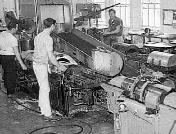
| Making Asbury Park Press Pay Initially, the computer explosion in the newspaper business was driven by the cost savings it promised. Newspaper analyst John Morton recalls that publishers saw the new technology as the miracle cure to mounting payroll costs. Most publishers recognized that they were going to be able, fairly quickly, to eliminate half the composing rooms. The Asbury Park Press was selling 27 thousand papers a day by 1960. Then, the suburban communities began springing up around the resorts and the population of central New Jersey. Almost overnight, the Asbury Park Press was trying to provide local coverage in an area that was almost 30 miles east to west and 60 miles north to south. They succeeded by creating a special section devoted specifically to each specific suburban community and the new technology has allowed newspapers to do that in a much more efficient way than before. Most importantly, the computers allow editors to tailor separate editions of the paper for different regions.In 25 years, the circulation of the Asbury Park Press has grown fivefold…from 27,000 to 127, 000 daily…190,000 on Sunday. At the same time, the paper’s size has grown and advertising lineage has doubled and tripled. Comment and Analysis by Richard Gill Under the pressures of the competition and the market, businesses, as we have seen, cut costs in many ways. They substitute less expensive inputs for the more expensive…high fructose corn syrup for sugar. They try to exploit economies of scale, as in the automotive industry. Most significantly of all, they can introduce, as the Asbury Park Press did, new technology innovations. |