
ECONOMICS U$A
MONOPOLY
To help viewers understand that the degree to which a firm controls the market affecgts prices and economic efficiency, and that the government tries to prevent or regulate monopolies.
OBJECTIVES:
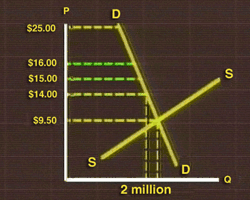
1. Market power is directly related to the producer’s ability to control the total production of a product and therefore keep prices and profits high.
a) At one extreme monopolists can control total output and therefore keep prices high – they are the price makers.
b) At the other extreme, in perfectly competitive markets, sellers have no control over prices – they are price takers.
2. The concentration of market power depends on entry barriers, e.g.:
a) ownership of a resource (e.g., oil) or process (e.g., patents on polaroid film) or transportation or marketing outlets.
b) economies of scale (e.g., the large fixed costs necessary to start a telephone company). Some markets, such as those for local utilities, have such large economies of scale, they are "natural monopolies."
c) even if entry barriers are high, some firms may try to compete with monopolies because the level of the monopolist’s profits are so high.
3. The more concentrated market power is in a given market the higher the likelihood that it is operating in a way which is economically inefficient for society as a whole. Producers with a high degree of market power are likely to set prices at a level which is higher than the level which would prevail in perfectly comptitive markets, and produce less than would be produced in a perfectly competitive market. From society’s point of view, this is not economically efficient.
4. The government tries to minimize or control monopolies:
a) if the market is not a natural monopoly, a monopoly may be dismantled by antritrust action.
b) in the case of natural monopolies, the government will regulate the firm.
KEY ECONOMIC CONCEPTS:
pools, trusts, perfectly competitive market,
holding companies, mergers,
monopoly profits, regulation,
economies of scale, natural monopoly, predatory pricing, entry barriers, monopoly power

|
Some analysts have suggested that because of national defense considerations, anti-trust rules might at times have to be waived – or at a minimum relaxed – for defense contractors. Under what circumstances would such a change in U.S. laws be justified? How would such a monopoly be different from a "natural monopoly" such as an electric utility? Would regulating a defense monopoly and providing it with the incentives to remain efficient and innovative be more of a challenge than for an electric utility? Does the fact that there is only one buyer (the government) of defense goods make this an inherently more difficult situation |
For a complete transcript of this video program download TVpdf#19
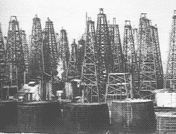
| Standard Oil The Sherman Act passed in 1890 was in response to the monopoly that John D. Rockefeller and his company Standard Oil had on the oil industry. Rockefeller did not take over the task of drilling for oil. Instead, he concentrated buyingt the oil that other men drilled--refining it and selling it. By 1869, he had the largest refinery in the country and a year later Standard Oil of Ohio was born. When competition squeezed profit margins, Rockefeller squeezed the competition. Willing competitors were bought. Unwilling competitors found themselves cut-off from railroads, pipelines, and credit. The Sherman Act made it illegal for any one firm to obtain a monopoly — that is to get complete control over the production of all the goods in one markets. Secondly, the Sherman Act made it illegal for firms to get together and agree on the way in which they would compete, for example, by setting prices or dividing markets or determining which customers they would deal with Despite the Sherman act it took awhile for the courts to finally break up Standard Oil. By 1911, competitors like Western Oil, like Gulf and Texaco had entered the refining business and had broken the Standard monopoly.That and the Sherman Anti-trust Act had ended the era of the big trusts. Comment and Analysis by Richard Gill The complaints against Standard Oil are based on the central economic critique of monopolies: they keep output too low, and their prices and profits are too high. Economists call these monopolies price-setters. On the other hand, firms whose prices are set in the market by supply and demand are called price-takers. |
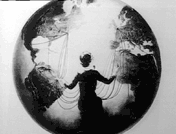
| Ma Bell Breaks Up After Alexander Graham Bell’s original patents expired around the turn of the century, competition for telephone service was tough. Bell slashed rates to undercut competitors. Others were cut off from equipment or from the long distance network which Bell controlled and which only Bell could afford. Independents asked the government to take Bell to court under anti-trust laws. Then in 1914, AT&T sent Nathan Kinsbury to Washington to set up a deal that would create a Natural monopoly. The key part of it was the commitment to refrain from buying up any more independent telephone companies, that it would provide long-distance connections to the independent, which means the non-Bell companies which then existed. The government bought this plan because what was promised was universal service. Bell would charge reasonable rates, and as a monopoly Bell could expand and give this integrated end-to-end service. It was good service. But because land lines had to be laid for the telephone wire, it was extremely expensive to provide and it would be inefficient for two or more companies to provide such lines However, with the advance of microwave technology, competition for long distance service became possible. The days of the protected Ma Bell monopoly were over. Comment and Analysis by Richard Gill This story illustrates the notion that a regulated monopoly makes sense when one factors in economies of scale. In most industries, after a certain level of production is reached, a business firm’s cost per unit of output tend to rise. But they may not do so. Because telephone customers need to be connected to each other, it may be very expensive to have several small-scale telephone networks servicing a region instead of just one larger one. |
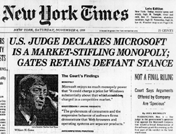
| Microsoft v. US Microsoft is the World’s largest software company. Every year for the last decade, Microsoft’s share of the market for personal computer operation systems has stood above 90 percent. Some of Microsoft’s business practices raises serious questions, and in 1998 the US government decided to file an antitrust lawsuit against the company. Microsoft realized early on that the internet had become a major inducement for consumers to buy personal computers. Access to the internet was controlled by a browser, first successfully developed by the Netscape Corporation in 1994. This posed a threat to Microsoft and that a browser had the potential to replace its operating system. Microsoft decided to develop its own browser, Internet Explorer, and incorporate it into the Windows operating system. The government argued that Microsoft was pursuing a strategy intended to drive Netscape out of business by co-opting the browser business and pulling it into the operating system so that an independent browser could not possible remain on sale.The government also claimed that Microsoft used its power to require its suppliers to give special deals to them that they did not give to special deals to them they did not give to competitors. It required some of its suppliers not to do business with Microsoft’s competitors in order to restrict competition. Microsoft argued that it was just providing a better, more innovative product that would benefit consumers. In October 2001 Microsoft and the government reached an agreement It was to make sure that Microsoft's anti-competetive practices would cease but it could continue to innovate and design its own products. Comment and Analysis by Nariman Behravesh The biggest check on Microsoft’s monopolistic behavior could be the rapid pace of technological change in the computer software and online industries. One of the government’s antitrust case was to prevent Microsoft from suppression either the development of new technologies or denying access to these new technologies as competitors. |