By CLARE FARNSWORTH
SEATTLE POST-INTELLIGENCER
October 4, 2002 |
Replacement
Sunday
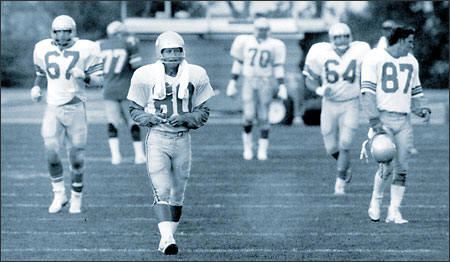
Replacement Seahawks arrive
at team headquarters for the second time on Oct. 15, 1987. The first
time the bus arrived, it turned around and went back to the players'
motel. |
|
A BRIEF HISTORY OF
NFL LABOR DISPUTES
1956:
Cleveland Browns players form first NFL Players
Association. Players from all 12 teams, with the
exception of Chicago, join the association. Don
Shula leads the effort in Baltimore.
1957: Players
ask for minimum salary of $5,000, a uniform per
diem, a rule requiring clubs to pay for players'
equipment and a provision requiring the continued
payment of salary to an injured player. Owners do
not respond to demands.
1957: Supreme
Court rules NFL in violation of antitrust laws.
Owners agree to many of the earlier demands by
players but never implement changes.
1960:
American Football League is formed, giving players
hope of better labor benefits due to competition.
But NFL owners dissuade players from joining AFL by
inserting clause in pension that voids payments if
players play for another league.
1966: AFL and
NFL merge, but their unions remain separate. Players
lack resources to challenge merger in court.
1968: After
Teamsters union agrees to help players, owners say
they will recognize NFLPA if Teamsters are rejected.
Players vote in favor of NFLPA, but owners still
refuse to bargain with union.
1968: NFLPA
threatens strike after pension demands are unmet,
but owners lock players out for a week. After a
brief strike, owners and players agree to first
collective bargaining agreement. NFLPA forced to
accept much less than demands because AFL Players
Association already had agreed to owners' demands.
1970: NFL and
AFL unions merge. NFLPA becomes first pro sports
union to be recognized by National Labor Relations
Board.
1970: After
brief lockout by owners, players go on strike. They
return after two days when owners threaten to cancel
season, and sides reach four-year agreement.
Following negotiations, many union player
representatives are let go by their teams; John
Mackey, the union head, is traded to San Diego and
is eventually forced to retire.
1971: NFLPA
hires its first executive director (attorney Ed
Garvey), establishes an office in Washington, D.C.,
and launches efforts to educate players.
1974: Owners
reject players' demands, which include guaranteed
payment of salaries. Players go on strike but give
up six weeks later and turn to the courts and
federal government.
1977: After
owners found guilty of violating federal labor and
antitrust laws, a settlement is reached. Benefits
increase, impartial arbitration of all grievances is
implemented, reforms in the waiver system and option
clauses are gained, and some free- agent
restrictions are ended.
1982:
Players, realizing that owners had no incentive to
spend on free agents because they shared revenue,
ask for 55 percent of league revenues, based on
years of service, playing time and individual and
team performance. Owners balk, and players go on 57-
day strike. Owners eventually agree to
salary/benefit package worth $1.28 billion from
1983-87. Owners forced to open books for first time
after players win ruling from NLRB.
1983: Gene
Upshaw, the former Oakland Raiders star, is selected
to succeed Garvey as NFLPA executive director.
Players tell him free agency is the highest priority
since only one of about 500 eligible players got a
free-agent offer in 1982.
1987: Players
demand free agency and go on strike when owners
balk. Owners field replacement players. Strike ends
after a month when players begin to cross picket
lines.
1989: After
losing antirust lawsuit the year before, NFL creates
"Plan B" free agency, in which teams retain rights
to 37 players each season. Teams can match any offer
from another team and receive compensation if the
player signs elsewhere.
1990: Owners
offer payments to players to abandon the NFLPA as
group licensing agent, threatening the major source
of revenue for the NFLPA's court battles and
strikes. Eventually, more than 700 players accept
the payments, which the union characterizes as
"bribes."
1992: Players
prevail in federal lawsuit that declares Plan B free
agency illegal. Jury decides system had a "harmful
effect" on competition, was too restrictive, and
that players suffered economic injury. League
appeals decision.
1993: After
players file antitrust lawsuit in the name of Eagles
end Reggie White, two sides settle on current
collective bargaining agreement, establishing the
"NFL system." Players win unrestricted free agency
for the first time, are guaranteed a higher
percentage of most league revenues and receive $195
million in settlement payments from the league. In
exchange, owners get salary cap to curb spending on
payrolls. |
Fifteen years ago today, the National
Football League did the unthinkable.
Faced with a strike by the NFL Players Association
and the loss of one weekend of games, the league played on Sunday, Oct.
4, 1987, without its players.
Instead, odd collections of oddball characters took
the fields in Seattle, Denver, Detroit, Washington, New Orleans and
seven other cities as the NFL unleashed replacement ball on what became
known as Replacement Sunday.
It wasn't pretty, but it was an interesting study in
human nature. Wannabes suddenly became NFL players, while highly paid
NFL players were thrust into the role of striking union workers.
"It was a good time, but it wasn't something I'm
necessarily proud of," said Tim Burnham, a former University of
Washington player who was the left tackle on the Seahawks replacement
team. "Personally, I came close to not doing it out of respect for the
Players Association, and what they were trying to achieve.
"But when I look back on it -- like a lot of people
who have crossed a picket line, for whatever reason -- most of them are
doing it not to be spiteful, but to simply give themselves an
opportunity," added Burnham, who now owns a construction supply company
in Bellevue.
The players who collected those three weeks of
memories -- and their 15 minutes of NFL infamy -- ranged from those who
would become noteworthy (Rick Neuheisel, now head coach at the
University of Washington), to those who are barely a footnote (Daryl
Baines, who was shot and killed a few years later while running away
from a crack house in Tacoma).
Replacement ball also spawned a new list of NFL
nicknames -- San Francisco Phoney Niners, New Orleans Saint Elsewheres,
Los Angeles Shams, Miami Dol-Finks, Seattle Sea-Scabs, Chicago Spare
Bears, and so on.
This three-week period has since been romanticized --
and misrepresented -- in the 2000 movie "The Replacements." Keanu Reeves
played the quarterback for the Washington Redskins replacement team, who
threw touchdown passes by day and wooed the bartending leader of the
dance team by night.
"I never saw it," Mike McCormack, who was in charge
of compiling the Seahawks replacement team that was coached by Chuck
Knox, said this week. "Somebody told me it wasn't very good."
Bill Bidwill, owner of the Arizona Cardinals, was
more direct.
"I don't want to see the movie," he said at the time.
"I might throw up."
A documentary of the Seahawks replacement team would
have been more realistic and entertaining.
"Not even close," Burnham said when asked to compare
the way the movie depicted the strike, and the way it really was.
Roll the tape:
The Decision
There had been a strike in 1982. Instead of
replacement games, there were no games -- for eight weeks, as the NFL
shut down.
No one could believe, or wanted to believe, that the
league and owners would actually play games in 1987 with hastily
thrown-together groups of former college players -- many plucked from
their jobs as cops, bouncers and construction workers.
"I don't think I've ever been in a more challenging
situation than this," Knox said on the eve of the Seahawks' first
replacement game, against the Miami Dolphins at the Kingdome. "I'm not
complaining about it. I'm not making excuses, because this is thrust
upon us, and we have to handle it the best we can."
So did the striking players -- especially Kenny
Easley, who went from intimidating strong safety to player rep and
spokesman for the striking Seahawks.
During the week leading up to the replacement ball
opener, while Easley was walking the picket line outside the team's
headquarters, an incredulous reporter remarked, "I can't believe they're
going to try and pass this team off as the Seahawks."
Easley's retort: "Believe it. They are going to do
this. And we're all going to have to live with it."
Assembling the Team
McCormack was a former player -- a Hall of Fame
tackle with the Cleveland Browns. Knox was a players' coach, who asked a
lot of his players but gave a lot in return.
Their devotion to the striking players put the
Seahawks at a disadvantage when it came time to assemble the replacement
team.
"We decided to wait," McCormack said. "We weren't
sure what was going to happen, whether we were going to field a team or
not. We weren't sure what the players were going to do. So we were just
kind of on hold."
The holding pattern left McCormack, assistant general
manager Chuck Allen and pro personnel assistant Randy Mueller leaving no
stone unturned in the scavenger hunt that was piecing together the
Seahawks replacement team.
They tracked down one offensive lineman while on a
hunting trip in Alaska. They found their fullback, Mike Hagen, at Power
International, a Bellevue-based ministry that spread "the word" by
having Hagan and others blow up hot-water bottles until they burst, rip
phone books in half and break 10 feet of ice with a head butt. They
coaxed wide receiver Curtis Pardridge away from an interview for a
stockbroker job in Sarasota, Fla.
One by one, they straggled into an Eastside motel the
night before they would take the practice field for the first time --
unsure of what was to come, not quite sure what they were doing.
"I knew some of these guys, and they knew who I was,"
said Burnham, who had met some of the Seahawks players while at the UW,
and also while working as a bouncer at Seattle nightspots. "I wasn't
just some tight end from Utah who had come in on the pickle truck, and
nobody knew me from nothing."
The next morning, the bus carrying the replacement
players to team headquarters was met by the striking players at the gate
that leads to the players' parking lot -- not to mention a cascade of
spit, and an avalanche of verbal abuse.
"As we pulled up, I'm thinking to myself, 'Why are we
stopping here? Do they want some kind of confrontation here?' " Burnham
said.
In one of the more surreal scenes from this drama
that was equal parts nightmare realized and dream come true, McCormack
emerged from the building and escorted the replacement players through
the gauntlet of striking players.
"It wasn't a difficult decision," McCormack said. "I
had mixed feelings, of course, being a former player and an ex-coach.
But I didn't want to leave those (replacement) players out there on
their own. They didn't know what was going on."
McCormack saved what proved to be his best move for
last, signing NFL journeyman quarterback Bruce Mathison a few days
before the opener against Miami.
The Games
With Mathison passing for 326 yards -- including a
47-yard pass on third down to Jimmy Teal that set up Rick Parros' 1-yard
TD run with 1:30 to play -- the Seahawks rallied to beat Miami 24-20.
A crowd of only 19,448 -- still the fourth largest on
Replacement Sunday -- roared its approval for this collection of players
who had been assembled during the previous 10 days.
"Any way you want to cut it, this was a great win for
this franchise," Knox said. "These kids went out there and battled and
scraped, and found a way to win."
Battled and scraped? Guard Ron Scoggins ran off the
field in the third quarter, the middle finger on his right hand puffed
up like a ballpark frank. He was met by Knox, who explained there was no
one to take his place. So Scoggins played the rest of the game with a
dislocated finger.
"I can't remember his name, but I remember that big,
ol' lineman doing that," McCormack said.
Knox marked the achievement by presenting game balls
to all 55 players.
"Some guys get them (game balls) every week. They
could care less," Mathison said at the time. "For guys who aren't
big-time stars, it's like getting a (Super Bowl) ring. They're
priceless."
Things didn't go as well the following week, when the
Seahawks lost to their Cincinnati counterparts, 17-10.
Before the Seahawks and other teams could get to the
third replacement game, it was the beginning of the end.
On Oct. 14, 89 players crossed the picket line --
including Seahawks wide receiver Steve Largent, center Blair Bush and
quarterback Jeff Kemp.
In the Seahawks' game at Detroit four days later,
Largent caught 15 passes for 261 yards in a 37-14 rout of the Lions
(Largent's 261 receiving yards was a career high).
After the game, then-Lions coach Darryl Rogers was
asked the obvious question: Why didn't he use double coverage on
Largent?
Rogers' response: "Why embarrass two players, when
you can just embarrass one?"
The End
After the game in Detroit, players had their pictures
taken in the locker room with teammates who had been strangers three
weeks earlier. They were celebrating as if they had played their final
game. For most, that was the case.
The next day, back in Kirkland, Knox said good-bye to
his replacement team and welcomed back his real team.
The strike was over.
"It was kind of a divided thing," McCormack said.
"You had a team on the practice field for those three or four weeks, but
you also had a group out there that you were concerned about and worried
about."
The 2-1 record compiled by the replacement team
helped the Seahawks finish 9-6 and advance to the playoffs. It also gave
players like Mathison, Teal and Burnham the chance to stay in the game a
little longer. Mathison and Teal stayed even after the strike ended,
while Burnham was signed and invited to training camp the next summer.
"I was going through some video tapes, maybe a week
ago, and I had one of the offensive series from those three games,"
Burnham said. "As I watched it, I was going, 'Man, I wasn't that bad a
football player.' "
For three weeks, 15 years ago, Burnham was part of
the only game in town.
FOUR WHO WERE THERE
A look at -- and memories from -- four men who were involved in the
1987 NFL players' strike, and the replacement games it prompted:
Mike McCormack
THEN: President/general manager of the Seahawks
NOW: Retired, with 10 grandchildren
MEMORY: "I was involved in the two previous strikes --
1974, when I was coaching the Eagles, and 1982, my first year in
Seattle. Between the three, they kind of run together. I had a
lot of mixed emotions in '87. But in '82, I stepped in after
Jack (Patera) was fired and coached the final seven games. So
that forced me to do something I said I'd never do again --
coach. In '87, I remember those young kids we put out there
tried as hard as any veterans. They didn't have all the skills
of the regular players, but they battled."
|
Rick Neuheisel
THEN: Quarterback, San Diego Chargers replacement team
NOW: Head coach, University of Washington
MEMORY: Neuheisel declined to discuss the part he
played in the 1987 strike by the NFL Players Association, but
his actions in two starts for the Chargers speak for him. He
still holds the club record for single-game completion
percentage -- .818, in an 18-of-22, 217-yard performance Oct. 11
at Tampa Bay. The head Husky also became the answer to a trivia
question: Name the last player to rush for a one-point
conversion. Neuheisel ran in a muffed point-after-touchdown
attempt in an Oct. 4 game at Cincinnati. The NFL now awards two
points for a rushing or passing PAT.
|
Nesby Glasgow
THEN: Strong safety and player rep, Indianapolis Colts
NOW: Seahawks director of player programs/alumni
MEMORY: "The one thing I remember about 1987, we
really had to make some tough choices. I think we did well to
hold out as long as we did. I still feel that the league --
actually the NFLPA -- has done an injustice to the guys who went
out on strike in '87. Because there's no way the players today
would be where they are today without the guys in '87 putting it
all out there on the line. We initiated change, and it actually
created a much better environment for players. . . . Was it
worth it? . . . Yes. Right now, the owners are happy, and for
the most part, the players are happy."
|
Tim Burnham
THEN: Left tackle for the Seahawks replacement team
NOW: Owner of a construction supplies company
MEMORY: "The first day of practice, the centers are
snapping the ball for punts and the ball is going everywhere.
Chuck Knox turns around and says, 'Can anybody long-snap?' Kent
Stephenson (the offensive line coach) turns and looked at me and
says, 'Burnham, you snap?' I told him, 'I've never done it in a
game, but I know I can do it.' That first game, I was the long
snapper."
|
© 1998-2006 Seattle Post-Intelligencer